So you want to get into cybersecurity. Good news, you don't need a computer science degree, you don't need to already know how to code, and you definitely don't need to be some genius hacker from the movies. You just need a starting point. That's what this roadmap is for.
What is Cybersecurity, Actually ?
Strip away the Hollywood stuff for a second. Cybersecurity is basically protecting computers, networks, and data from people who want to break in, steal, or mess things up. That's it. Some people do this by finding weaknesses before bad actors do, called ethical hacking or penetration testing. Some people build the walls and alarms, called defense or blue team work. Some people just watch for suspicious activity all day, like a security guard for a network. Every website you use, every app on your phone, every company you've ever heard of, they all need people doing this work. That's why the field isn't going anywhere.
Different Career Paths in Cybersecurity
Here's something nobody tells beginners early enough, cybersecurity isn't one job. It's a bunch of different paths, and you get to pick the one that actually fits how your brain works.
Penetration testers, also called ethical hackers, get paid to break into systems legally, before the bad guys do. It's called red team work too, sometimes. Good fit if you enjoy poking at things, finding cracks nobody else noticed.
Blue team is the flip side, building firewalls, setting up defenses, making sure attackers can't get in easily, or catching them fast if they do. Good fit if you like building solid systems, thinking a few steps ahead of trouble.
SOC analysts, short for Security Operations Center, spend their day watching logs and alerts, looking for anything weird happening on a network. Less about attacking or defending directly, more about constant awareness, catching the signal in a lot of noise. Beyond these three, there's digital forensics, investigating after something's already gone wrong, piecing together what happened. Security research, studying new threats and vulnerabilities before they become widespread problems. Cloud security, a newer, fast growing lane, since almost everything lives on cloud servers now. You don't need to pick your final path today. Just know these options exist, so you're not wandering blind, and so you don't accidentally think cybersecurity means just one narrow thing.
Skills You Actually Need First:
Before you touch any hacking tool, there's a few basics you genuinely need. Skip these, and you'll hit a wall fast later. Networking basics come first. You need to understand how computers talk to each other, what an IP address is, what a port is, how data actually moves around. Sounds boring, but it's the foundation everything else sits on. Operating systems next, specifically Linux. Most security tools live on Linux, most servers run on Linux, so getting comfortable navigating it, not mastering it, just comfortable, is non negotiable. Basic scripting helps a lot too. You don't need to become a software engineer. Just enough Python or Bash to automate small tasks, understand what a script is doing when you run someone else's tool. Even reading code, without writing much yourself, gets you far early on.
How to Actually Practice:
Reading about cybersecurity only gets you so far. At some point, you need to actually do it, safely, legally, in an environment built for practice. This is where platforms like TryHackMe and HackTheBox come in. Think of them as gyms, except instead of lifting weights, you're solving security challenges, breaking into practice systems that are intentionally left vulnerable for you to learn on. Completely legal, completely safe, built exactly for beginners to learn hands on. You'll also hear the term CTF a lot, short for Capture The Flag. These are competitions, sometimes solo, sometimes team based, where you solve security puzzles to find hidden flags, basically secret codes proving you solved the challenge. They're a genuinely fun way to learn, feels more like a game than studying. Start small here. Don't jump into advanced challenges on day one, you'll just get frustrated. Beginner labs exist for a reason, use them.
Skills You Actually Need First
Before you touch any hacking tool, there's a few basics you genuinely need. Skip these, and you'll hit a wall fast later.Networking basics come first. You need to understand how computers talk to each other, what an IP address is, what a port is, how data actually moves around. Sounds boring, but it's the foundation everything else sits on.Operating systems next, specifically Linux. Most security tools live on Linux, most servers run on Linux, so getting comfortable navigating it, not mastering it, just comfortable, is non negotiable.Basic scripting helps a lot too. You don't need to become a software engineer. Just enough Python or Bash to automate small tasks, understand what a script is doing when you run someone else's tool. Even reading code, without writing much yourself, gets you far early on.
Tools of the Trade
You'll hear a lot of tool names thrown around once you start looking into this field. Let's demystify a few of the big ones so they don't feel intimidating. Kali Linux is basically an operating system built specifically for security work, it comes preloaded with hundreds of tools testers and hackers use daily. Think of it as a toolbox that's already packed, instead of buying every tool separately. Virtual Machines, or VMs, let you run Kali, or any other operating system, inside your regular computer, safely, without touching your actual files or system. This matters a lot, because a lot of security practice involves testing things you don't want running directly on your real machine. Wireshark is a tool that lets you see exactly what's happening on a network, every bit of data moving around, visible and readable. Sounds complex at first glance, but it's genuinely one of the coolest tools once you get comfortable with it. You don't need to learn all of this today. Just know these names, you'll be introduced to each one properly, one at a time, in upcoming posts.
How to Actually Practice
Reading about cybersecurity only gets you so far. At some point, you need to actually do it, safely, legally, in an environment built for practice.This is where platforms like TryHackMe and HackTheBox come in. Think of them as gyms, except instead of lifting weights, you're solving security challenges, breaking into practice systems that are intentionally left vulnerable for you to learn on. Completely legal, completely safe, built exactly for beginners to learn hands on.You'll also hear the term CTF a lot, short for Capture The Flag. These are competitions, sometimes solo, sometimes team based, where you solve security puzzles to find hidden flags, basically secret codes proving you solved the challenge. They're a genuinely fun way to learn, feels more like a game than studying.Start small here. Don't jump into advanced challenges on day one, you'll just get frustrated. Beginner labs exist for a reason, use them.
A Simple Stage by Stage Roadmap
Here's how I'd actually break this down if I was starting from zero today. No pressure to rush any stage, everyone moves at a different pace. Stage one, get comfortable with computers and networking basics. Understand how the internet actually works, what happens when you type a website address and hit enter, what IP addresses and ports even mean. Don't skip this thinking it's too basic, it isn't. Stage two, learn Linux, specifically get comfortable inside Kali Linux. Set it up on a virtual machine, poke around, get used to the command line, don't be scared of typing commands instead of clicking buttons. Stage three, pick up basic scripting. A little Python, a little Bash. Enough to understand what a script does when you run it, enough to automate a small repetitive task. Stage four, start practicing on beginner friendly platforms, TryHackMe has actual beginner paths built for exactly this stage. Go slow, take notes, don't rush. Stage five, try your first CTF, even if you don't solve much, the exposure itself teaches you a ton. Join a community, Discord servers, forums, other beginners going through the same thing, learning alone is harder than it needs to be. Stage six, start narrowing down, pentesting, blue team, cloud security, whatever caught your interest along the way. This is where you go from general beginner to building real specialized skill.
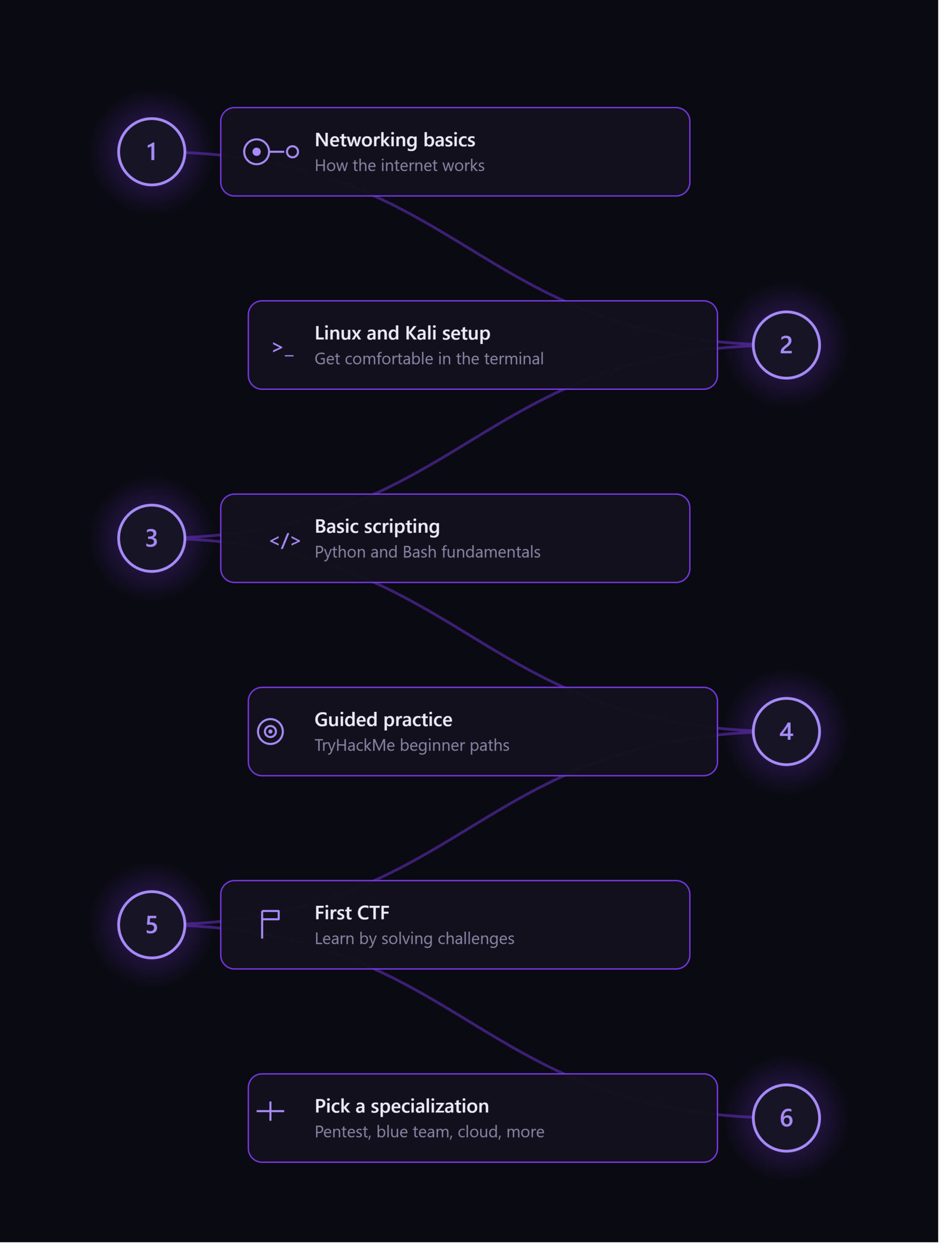
That's the roadmap, start to finish. No degree required, no genius IQ required, just curiosity and consistency, showing up regularly beats sudden bursts of motivation that fade out in two weeks. This is just the starting point though. Every stage here, Kali setup, VM setup, scripting basics, your first CTF, I'll be covering each one properly, step by step, in upcoming posts. So if this roadmap got you even a little excited, stick around, follow along, we're building this together.